
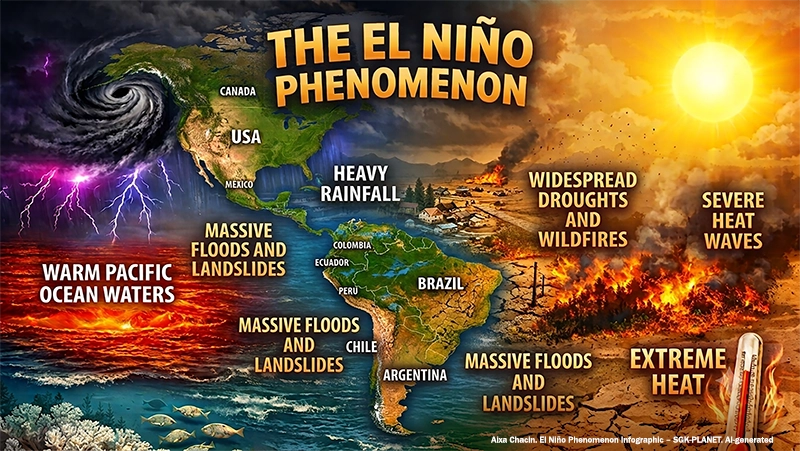
The 2026 El Niño phenomenon is already a reality.
The planet is facing one of the harshest climate conditions of recent decades. Forecasts predict record ocean temperatures and atmospheric disruptions, creating a landscape divided between devastating droughts in some regions and catastrophic rainfall in others.
Below, we analyze the scope of this climate threat and its impact across the continents.
What is El Niño 2026, and how does it alter global temperatures?
The El Niño phenomenon—scientifically known as the El Niño-Southern Oscillation (ENSO)—is a climate event linked to the warming of the Tropical Pacific Ocean (TPO).
Surface water temperatures in the TPO remain high year-round, generally between 25°C and 30°C; this is the region where the El Niño and La Niña cycles originate. Both climate phenomena significantly alter rainfall and temperature patterns, influencing the entire planet.
The U.S. National Oceanic and Atmospheric Administration (NOAA) and the World Meteorological Organization (WMO) have detected intense warming in the waters of the equatorial Pacific.
According to reports, “there is a high probability that the El Niño phenomenon will persist into the early months of 2027, reaching a critical peak between October and December 2026.”


Impacts of El Niño 2026 in the Americas: Droughts and Floods
According to reports updated as of September 2026, the probability of the El Niño phenomenon reaching peak intensity is nearing 100%, with water warming estimated at close to 3.4 degrees above the normal average.
A news update from while we were writing
“On Wednesday, the United States government declared a drought disaster in more than twenty cities and towns across Puerto Rico, as water issues worsen island-wide with no relief in sight.” Dánica Coto. AP (2026).
In South America
Rainfall deficits, droughts, and high temperatures are forecast for the north, affecting Venezuela, Colombia, and the Guianas.
A surplus of precipitation and frequent storms is predicted for the southern zone, including southern Brazil, Paraguay, Argentina, and central Chile.
Coasts and oceans: An alert is in effect due to rising sea-surface temperatures and the persistence of warm coastal phases, with forecasts of heavy rain along the coastal strip.
Impact of the 2026 El Niño on other global regions

Oceania and Southeast Asia (across the equatorial Pacific):
Severe droughts and a high risk of wildfires are expected, leading to water shortages in Australia, Indonesia, and the Philippines. This threatens to destabilize global agricultural production of key crops such as rice and wheat.
Sub-Saharan and East Africa
Highly irregular rainfall patterns are anticipated. A stark contrast is expected: severe droughts in Southern Africa alongside excessive rainfall in the Horn of Africa, increasing food insecurity for these populations.
East Asia and the Indian monsoon
Rising water temperatures are expected to disrupt typical monsoon winds. This would result in a drier-than-normal summer for the Indian subcontinent, significantly reducing local water resources.
Europe and Northern Eurasia
While the direct impact on these regions is generally milder or indirect compared to the tropics, alterations in jet stream patterns are being observed. This condition fosters atypical winters, which may be milder than usual or marked by abrupt shifts in winter rainfall and snowfall patterns.
How climate change affects ENSO forecasting
Climate change adds complexity to ENSO forecasting. Sea surface temperatures (SSTs) are rising globally, with the increase being particularly pronounced in the western Pacific. Conditions in early 2026 are expected to be warmer than in 2023, while the impact of greenhouse gases continues to grow.
Scientific reports confirm that global warming is clear evidence that human-induced climate change is increasingly affecting all the world’s oceans.
Oceans absorb more than 90% of the excess heat trapped by greenhouse gas emissions generated by humanity—primarily through the burning of fossil fuels.
According to Dr. Samantha Burgess, Deputy Director of Copernicus: “This record is another clear sign that the ocean is under increasing stress.” She adds, “El Niño is adding heat to the system, but it is doing so on top of decades of warming…”
Aixa Chacin
Editorial Director SGK-PLANET
Sources consulted
Coto, Danica. (2026, August 26). US declares drought disaster for parts of Puerto Rico as dry conditions persist. AP News. https://apnews.com/article/puerto-rico-drought-disaster-usda-farmers-water-b4fe620ecbb2272576e79d140f0180dd
World Meteorological Organization (WMO). News. (2026, September 3). El Niño set to become very strong, raising risks of extreme weather into 2027. https://wmo.int/media/news/el-nino-set-become-very-strong-raising-risks-of-extreme-weather-2027
Poynting, Mark. (2026, August 24). World’s oceans hit highest temperature on record as El Niño grows. BBC News Mundo. https://bbc.com/news/articles/c62m4gpnp78o
UN News. Global perspective Human Stories. (2026, July 31). Strong El Niño ahead, UN weather agency warns. https://news.un.org/en/story/2026/07/1168059
Saulo Celeste. (2026, 3 de septiembre). An exceptional El Niño demands an exceptional response. Declaración de la Secretaría General de la Organización Meteorológica Mundial (OMM). https://wmo.int/content/exceptional-el-nino-demands-exceptional-response



Leave A Comment