
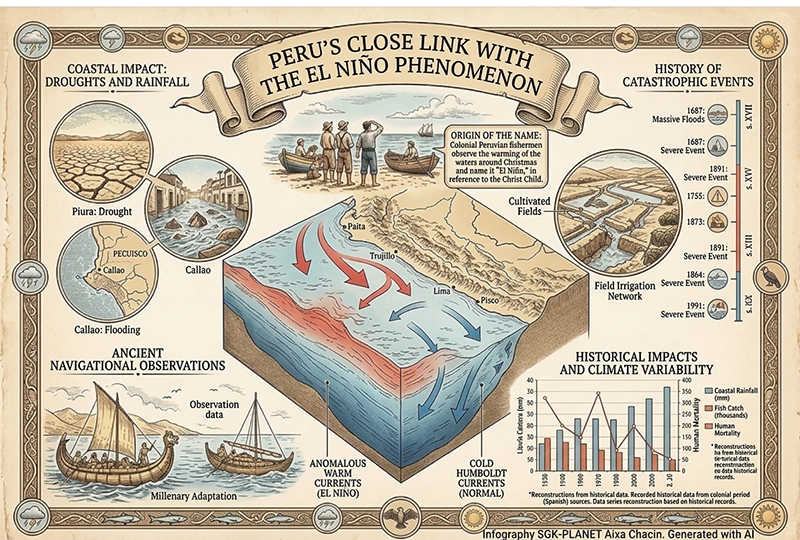
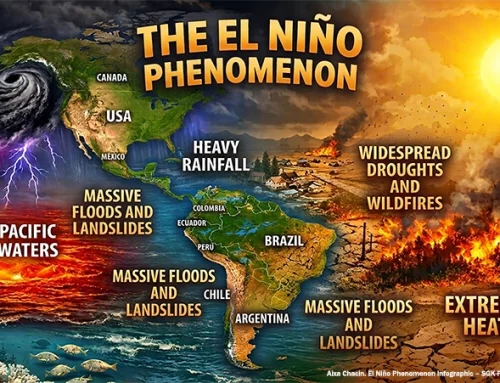
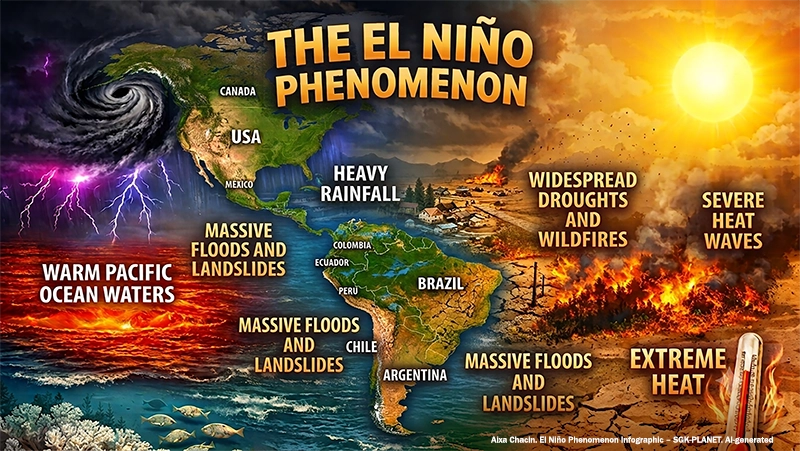
Peru is closely linked to the El Niño phenomenon. In this South American country, the northern coast is the geographic focal point for anomalous ocean warming, which directly alters the Humboldt Current ecosystem and the region’s climate.
Fishermen as Key Figures
The connection is so strong that fishermen from northern Peru named the El Niño phenomenon in the 19th century; they noticed a warm current arriving around Christmas time, leading to the name “El Niño” (referring to the Christ Child, or El Niño Jesús).
Impact on the Peruvian Coast
El Niño has profound consequences for the Peruvian coastline; originating along these shores, the phenomenon deeply influences the nation’s history, economy, and rich biodiversity.
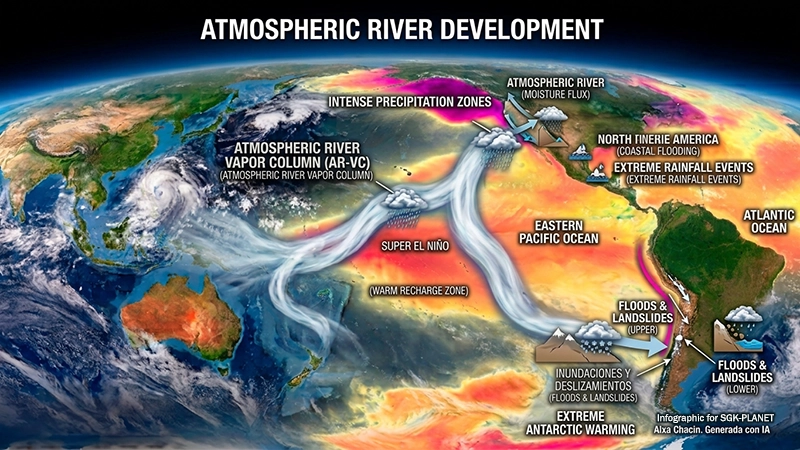
Warming waters in the eastern Pacific directly impact the Peruvian coast. As trade winds that typically move warm water toward Asia weaken, ocean currents reverse and gather along the coasts of Peru and Ecuador. This disrupts the area’s usual cold Humboldt Current, allowing sea temperatures to rise abnormally.
Historical Records
During the 20th century, before the extraordinary El Niño event of 1997–98, approximately 25 El Niño episodes occurred with varying intensity. Historical records indicate that the El Niño events of 1891 and 1925 were comparable in intensity to those of 1982–83 and 1997–98.
So far in the 21st century, NOAA’s Oceanic El Niño Index (ONI) records four El Niño episodes in the central Pacific: two weak (2004–05 and 2006–07) and two moderate (2002–03 and 2009–10).
Sandor Alejandro Gerendas-Kiss
Editor of SGK-PLANET
Source
Servicio Nacional de Meteorología e Hidrología del Perú (SENAMHI) (2014). El fenómeno de El Niño en el Perú y sus características. SENAMHI. Año 2014.



Leave A Comment