
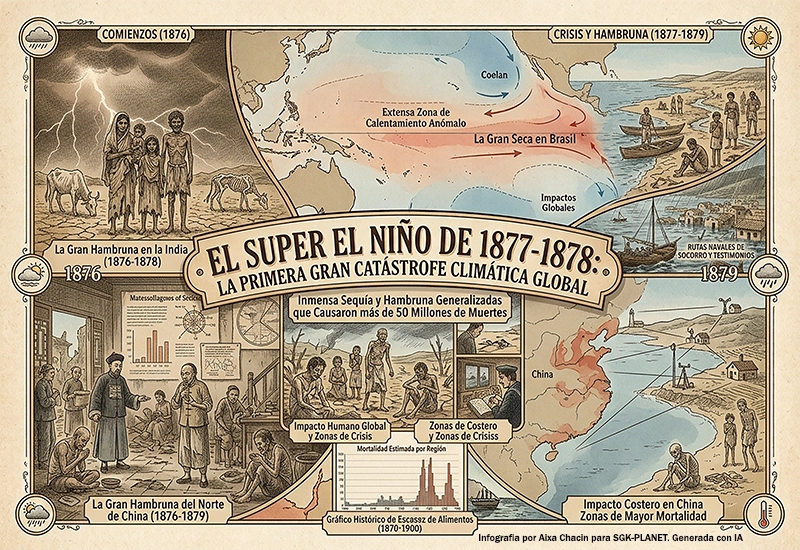
The first major global climate catastrophe
The Super El Niño phenomenon of 1877-1878 is the most intense documented so far. This phenomenon contributed to widespread drought and famine in several countries, causing the deaths of more than 50 million people.
These are the three countries that suffered the most from the Super El Niño
- The Great Famine in India (1876–1878)
- The Great Drought in Brazil (1877–1878)
- The Great North China Famine (1876–1879)
As you can see, 1877 appears in all three regions.
-
The Great Famine in India (1876–1878)
In India, the Great Famine occurred during British Crown rule. It began after the 1876 monsoon rainfall, causing severe crop losses.
It began with a severe drought in 1876 that caused crop failures in the Deccan. The regions most affected were southern and eastern India (specifically the British Presidencies of Madras and Bombay and the princely states of Mysore and Hyderabad). It is estimated to have lasted two years.
The famine intensified during its second year, spreading northward into the Central Provinces, the North-Western Provinces, and a small part of the Punjab.
This phenomenon affected the region’s population, estimated at approximately 58.5 million people. The death toll in India from this famine is estimated at 5.5 million. WP
-
The Great Drought in Brazil (1877–1878)
Known in Portuguese as A Grande Seca, the Great Drought occurred in Brazil between 1877 and 1878 and was the country’s most severe and devastating drought in history. It stemmed from poorly managed agriculture.
Overgrazing, the sharecropping system, and a lack of sustainable farming practices worsened the drought’s effects. Most of the population in Brazil’s *sertão* (rural hinterland) consisted of impoverished sharecroppers who relied on winter rains to provide water for their crops and livestock.
Without adequate preparation, *sertão* farmers were ill-equipped for a prolonged drought and soon began to starve. It is estimated that the death toll reached between 400,000 and 500,000 people. WP
Of the 800,000 inhabitants living in northeastern Brazil—the region most severely affected—approximately 120,000 are known to have migrated to the Amazon, while about 68,000 moved to other parts of the country.
-
The Great Northern Chinese Famine (1876–1879)
The Great Northern Chinese Famine of 1876–1879 was characterized by crop failures resulting from a prolonged drought, which led to widespread famine.
It is estimated that between 9,500,000 and 13,000,000 people died in China during the famine, most notably in Shanxi province, which saw 5,500,000 deaths. The famine also affected the provinces of Zhili (present-day Hebei), with 2,500,000 deaths; Henan, with 1,000,000; and Shandong, with 500,000.
Census data, which accounts for both famine-driven deaths and migration, indicates a total population decline of 23 million people. WP
Sandor Alejandro Gerendas-Kiss
Editor of SGK-PLANET




Leave A Comment