
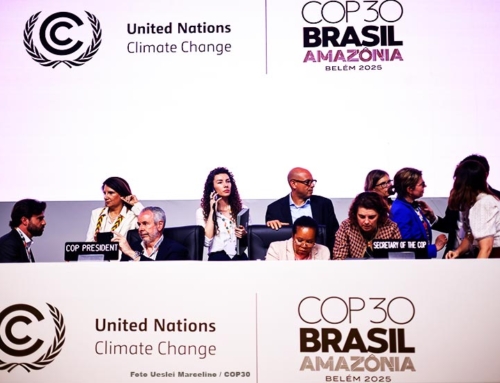
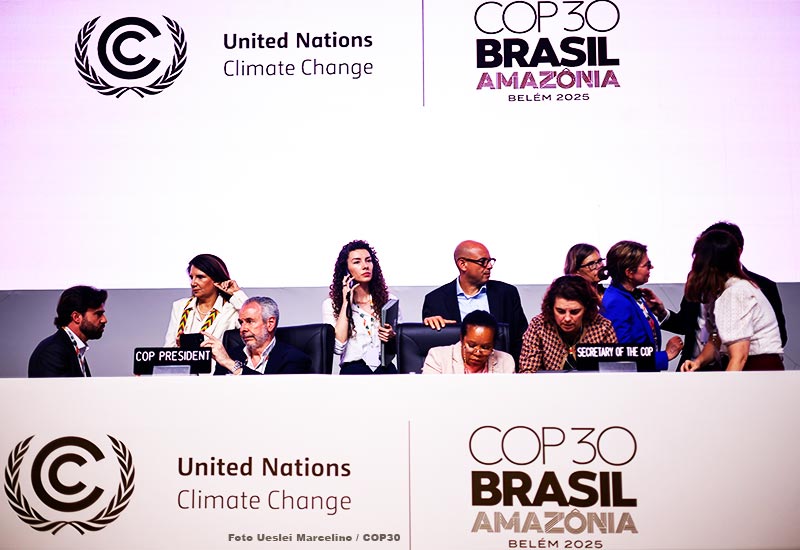
COP 30 will be held in 2025 in Belém, Brazil, from November 10 to 21. Three decades have passed since COP 1 in Berlin, 1995, until COP 30. This period marks an important milestone in our planet’s climate. Thirty is a round number, ideal for taking stock of the achievements and failures of the COPs during this period.
As we know, COP conferences are the highest international negotiation body on climate change, where countries—called Parties—make decisions to try to curb climate change. The COPs are convened annually by the United Nations Framework Convention on Climate Change, better known as the UNFCCC.
Currently, the UNFCCC is made up of 197 parties, including all United Nations member states, Niue, the Cook Islands, and the European Union.
The inevitable question is: what has been the outcome of the COPs after three decades? This question must be answered as soon as possible, by both the authorities and the parties involved, regarding the quantitative and qualitative results of these thirty years. COP30 is the ideal setting to debate this and to put a stop to the global warming that our precious blue ship, called Earth, is suffering.
At SGK-PLANET, we focus on the temperatures that thermometers have been recording over the past three decades. In short, we draw conclusions based on the numbers and annual curves expressed in different temperature tables.
The figure presented here shows that the curve has not stopped rising from the first COP (1995) to COP30. The gradual increase, after many annual, mid-year, and other special climate conferences, is alarming.
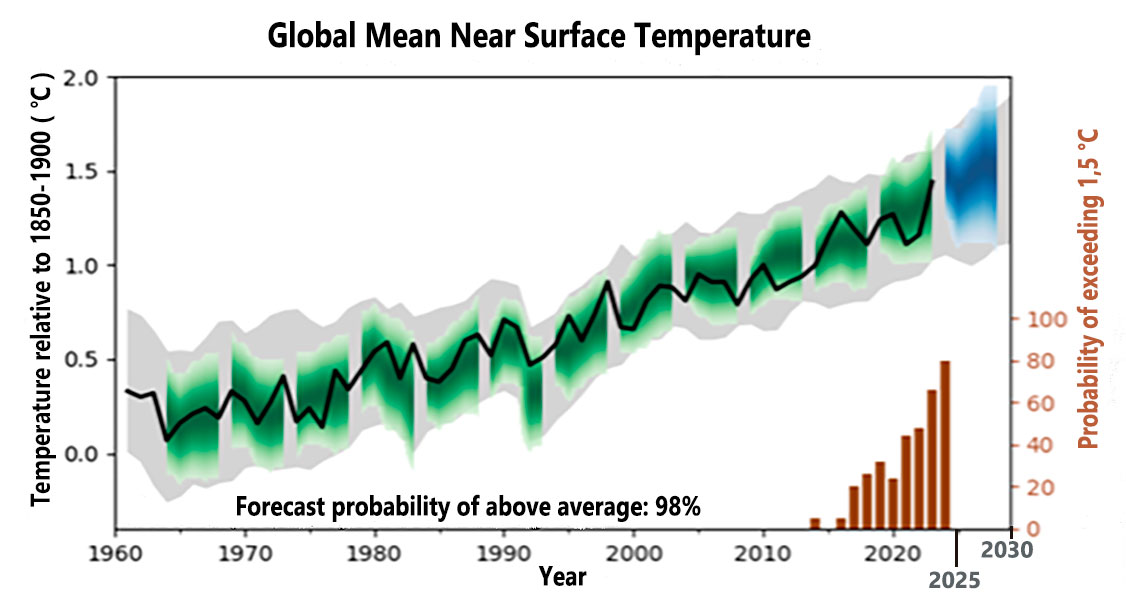
Figure. Average global temperature near the surface. Translation by Aíxa Chacín.
Source: World Meteorological Organization (WMO). Data provided by the 2025 WMO Global Annual to Decadal Climate Update. Target years: 2024 and 2024-2028.
Credits: World Meteorological Organization (WMO).
Image: WMO available from https://library.wmo.int/idurl/4/68910
Note: The probability that the global mean annual near-surface temperature in 2024-2028 will exceed 1.5°C above 1850-1900 levels for at least one year is 80% and increases over time (brown right axis in the Figure).
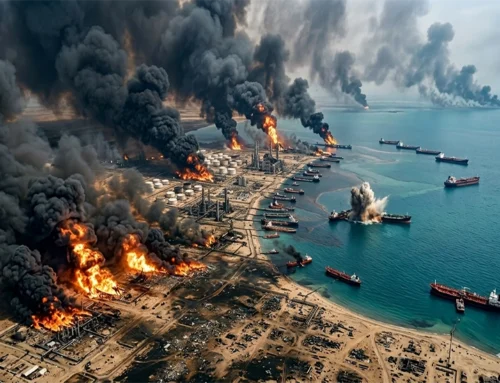
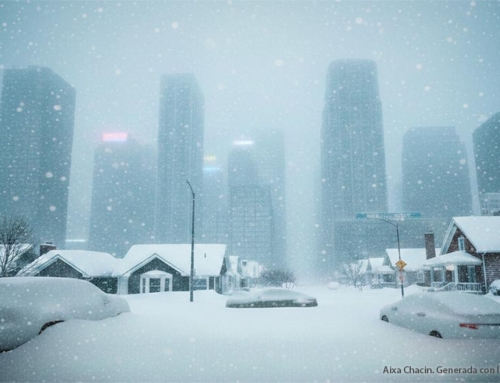
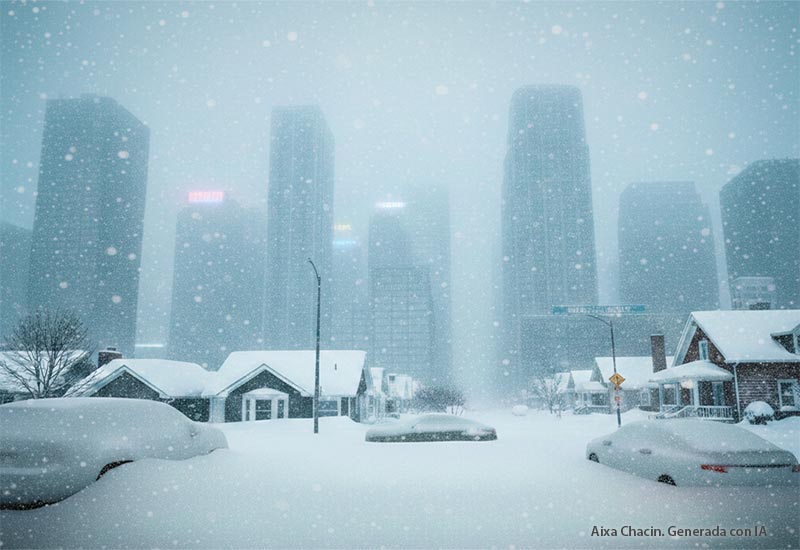
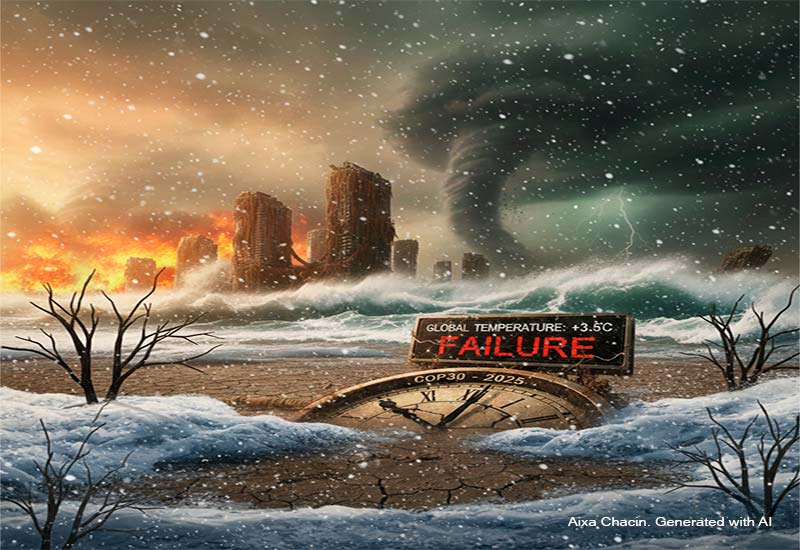
In the 2024-2025 period, climate change, as a consequence of global warming, has not been long in coming and has become extremely severe. We are referring to the catastrophic natural disasters that have occurred in different parts of the globe.
Thus, we have seen the droughts in Spain, an increase in extreme temperature events in Asia, severe droughts in Africa, floods in some South American cities, and devastating tropical storms in the United States. In 2025, intense wildfires have been reported in North America, as well as severe storms and tornadoes in various regions of the world.
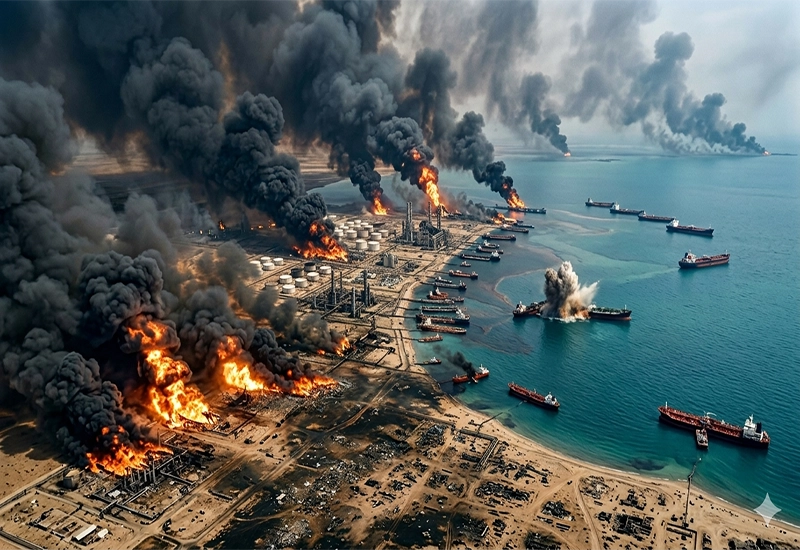
The extreme scarcity of drinking water deserves a separate paragraph: regions such as the Middle East and North Africa are particularly affected. Some countries include Qatar, Israel, Lebanon, Iran, Jordan, Libya, Kuwait, Saudi Arabia, Eritrea, the United Arab Emirates, San Marino, Bahrain, India, Turkmenistan, Oman, and Botswana. Countries like Mexico, Spain, South Africa, and Australia are experiencing worrying levels of water stress, a consequence of extreme droughts and desertification, which are in turn caused by global warming, primarily driven by greenhouse gas emissions from burning oil and natural gas.
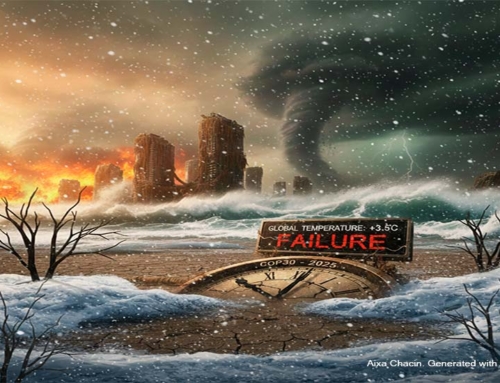
We cannot allow any more time to pass. What is coming our way is not a game if we do not act urgently. Our intention is not to warn us, but rather to warn that we must take the situation very seriously and act in proportion to the looming dangers.
Hopefully, COP30 will not be another tournament of words, sayings, and unfulfilled promises, but rather the forum that was established 30 years ago to address imminent climate dangers.
Sandor Alejandro Gerendas-Kiss
Editor of SGK-PLANET

Leave A Comment