
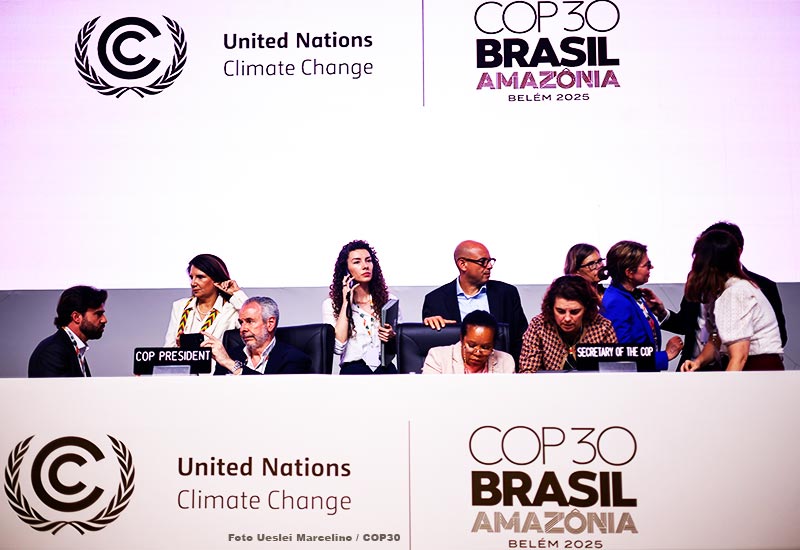
General Information
Event Dates: November 10-21, 2025
Name: COP30 or 30th Conference of the Parties, Belém 2025, Amazonia Brazil
Main Topics: Climate finance, emissions mitigation, climate change adaptation, fossil fuel reduction, forest protection, and biodiversity support
Leaders absent from COP30: Donald Trump (USA), Xi Jinping (China), Vladimir Putin (Russia), and Narendra Modi (India), leaders of the world’s largest polluters. Also absent were Giorgia Meloni (Italy) and Javier Milei (Argentina). The absence of these leaders foreshadowed what followed.
Location of COP30: Belém do Pará, Amazon, Brazil
Objectives: Implementation of climate commitments, with a focus on the energy transition, building resilient societies, and financing climate projects.
President of COP30: André Aranha Corrêa do Lago, 1959. Is an economist and diplomat, graduated from the Federal University of Rio de Janeiro. He joined the Brazilian foreign service in 1982.
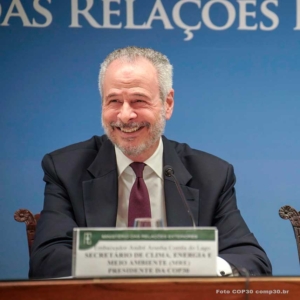
COP30 Motto: “Less talk, more action”
Logo COPO30:
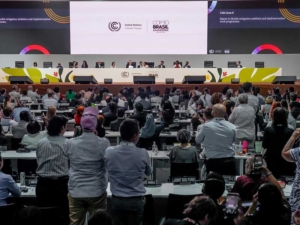
The Auditorium: Belém do Pará, City Park, Blue Zone. COP30 Plenary Hall.
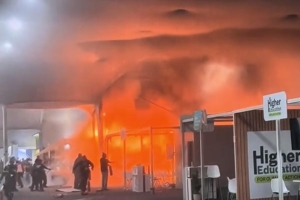
The Belém Fire
On Thursday, November 20, 2025, the COP30 headquarters suffered a fire that alarmed the local community. The fire and smoke forced the evacuation of thousands of people and the suspension of the negotiations in their final stages, which were postponed until the following day.
Before we continue
The temperature curve, COPs, and other climate conferences
They say that “words are carried away by the wind”, but it is also said that “numbers don’t lie”.
With this in mind, we have constructed the attached diagram, an original model from SGK-PLANET, which demonstrates that from 1972 to the present day (53 years later), and despite Stockholm ’72, Rio ’92, Kyoto ’97, Paris ’15, plus 30 COP conferences and numerous half-year conferences, the temperature curve continues its relentless rise.
This is very dangerous and reminds us of the old saying: “you reap what you sow”. Applied to the climate issue, this means that the “sow” represents our inaction, and the “sludge” represents the increasingly extreme and unbearable heat waves for humans and most other species.
The problem of rising temperatures became evident from the 1950s onward, when the upward curve became constant and seemed predictable, even later, when climate conferences began to be held annually and semi-annually, which speaks to the ineffectiveness of these conferences.
COP30: Conference of the Parties or Conference of Deniers?
The Secretary-General of the United Nations, António Guterres, gave his first speech at a pre-COP30 event in Belém, in which he stated: “We have failed to meet the goal of limiting global warming to 1.5°C above pre-industrial levels.”
He also acknowledged that the new climate plans of each country and their commitments to reducing greenhouse gases represent progress but pointed out that “they are still far below what is needed… meanwhile, the climate crisis is accelerating.”
COP30: Conference of the Parties or Conference of the Deniers? These admissions are alarming and frustrating for those of us who live on this planet, and especially for us environmentalists who fight against climate change year-round. Nevertheless, we appreciate the Secretary-General’s acknowledgment of these serious facts, something uncommon in today’s world.
Fifteen days of negotiations during COP30 culminated in an agreement to renew climate commitments in the face of rising temperatures. However, any mention of fossil fuels, the main cause of global warming, was omitted, which, in turn, effectively nullifies the roadmap for oil, gas, and coal—one of the central motivations of COP30.
The issue of oil lobbyists
These lobbyists managed to ensure that fossil fuels were not even mentioned in the final document. This was nothing less than the central theme of COP30.
COP30 concludes by removing any mention of the phase-out of fossil fuels from the final document.
The protest erupted in delegations such as those from Argentina, Colombia, Ecuador, Panama, Uruguay, and Paraguay, even leading to the temporary suspension of the closing plenary session. Delegates alleged that several representatives had not been given the opportunity to speak, thus denying them the right to voice their objections to the agreement.
When Irene Vélez Torres, Colombia’s Minister of the Environment, finally took the floor, she expressed her discontent:
“Colombia will not accept a text that denies science, prevents the achievement of the 1.5°C target, and turns its back on the people and on life itself”. This was reported by RTVE.
There is no objection to what Irene Vélez said.
And it is unbelievable that climate change deniers were able to take control of COP30 without any shame. On the last day of COP30, the situation reached a breaking point. No one could have predicted before the conference began that the very actors—the fossil fuel producers—would go so far, as reported by the most prestigious media outlets.
And the BBC, in its conclusions, stated, “Many countries were outraged when COP30, held in Belém, Brazil, ended on Saturday without even mentioning fossil fuels, the main cause of global warming, as already stated”.
For example, InfoAmazonia pointed out, “National governments reached a consensus on a series of decisions that barely meet the ambition that both some countries and civil society expected… zero commitment to advance the transition away from fossil fuels and weak decisions on the implementation and financing of adaptation policies”.
Among other points of contention was the lack of transparency, as the data on the new climate change adaptation indicators that had been discussed and approved in previous sessions were not presented. Instead, a set of 59 indicators was presented, modified after the fact, and the scientific metrics used to determine them were neither specified nor considered.
Meanwhile, a large group of young delegates spent the entire day (November 23, 2025) in the main auditorium, striving to deliver their concluding remarks, cramming as many words as possible into the meager five minutes allotted to each group. These delegates represented civil society and non-governmental organizations that had been participating in the exchange and discussion spaces in the Green Zone during COP30.
I spent a few hours watching and enjoying these young people speaking at breakneck speed, congratulating one another with boundless enthusiasm, seemingly oblivious to what had transpired in the auditorium.
As a final point, the COP30 president pledged to work throughout his year-long presidency to achieve the “roadmaps” for managing and controlling deforestation, as well as to advance the gradual reduction of fossil fuels until their elimination.
In conclusion, at SGK-PLANET we believe the outcome of COP30 is serious, given the message it sends to the world’s people. We hope we don’t see temperature trends rise any further than they already are and that the effects of this don’t manifest as an increase in natural disasters.
We believe that climate authorities should provide some explanations to humanity.
Sandor Alejandro Gerendas-Kiss
Editor of SGK-PLANET

Leave A Comment